If It’s Not on the Calendar, It’s Not in the System!
As co‑author of MTSS for Reading Improvement and creator of the MTSS Data Academy, I spend a lot of time with schools helping to connect the science of reading and MTSS into one coherent system. A significant part of that work is in supporting educators and leaders to be confident in taking action on the high-quality reading data they already have. The very first step is to ensure that meetings are set aside specifically for teams to review their screening and progress monitoring data.
If data conversations only happen when teams have extra time, decisions about screening, interventions, and progress monitoring are inconsistent and often reactive. Students who most need coordinated support are often the ones who slip through the cracks. Additionally, all educators in the school fail to build the confidence with data that leaders hope they have. This is a great time to review the yearlong calendar of data meetings for grade‑level teams/PLCs, Building Leadership Teams (BLTs), and District Leadership Teams (DLTs), and consider how to use existing teams to maximize the impact of already-existing student data.
In this article, we’ll consider 3 big ideas
Maximize Screening Data Use at all Tiers
Consider Progress Monitoring Data Use
Remember Team Membership Matters
From an MTSS Person, Place or Time to a System
In MTSS for Reading Improvement, we argue that sustainable gains come from designing “interventions for the system,” not just piling on more interventions for individual students. We wrote the book as a tool kit, with practical tools, including meeting agendas, data protocols, and planning templates, to make that work doable for busy school and district leaders.
The MTSS Data Academy builds on that same idea. It’s a research‑based program that brings MTSS, the science of reading, and team data coaching together, with a yearlong sequence of trainings, drop-in coaching sessions, and ready‑to‑use resources. When schools pair the Academy’s calendar and coaching with the tools from MTSS for Reading Improvement, teams stop relying on ad‑hoc conversations and start running predictable, high‑quality data-use cycles that build team collaboration and collective teacher efficacy that shift MTSS from being about one person or a time of day, to just the way the school operates.
Anchor meetings to screening and progress monitoring
Your assessment calendar already outlines when universal screening and progress monitoring will happen and your data meetings should sit align to those dates.
A simple rule I share in the MTSS Data Academy sessions is: schedule key data meetings for the week after each screening window closes. Here’s one pattern you can adopt:
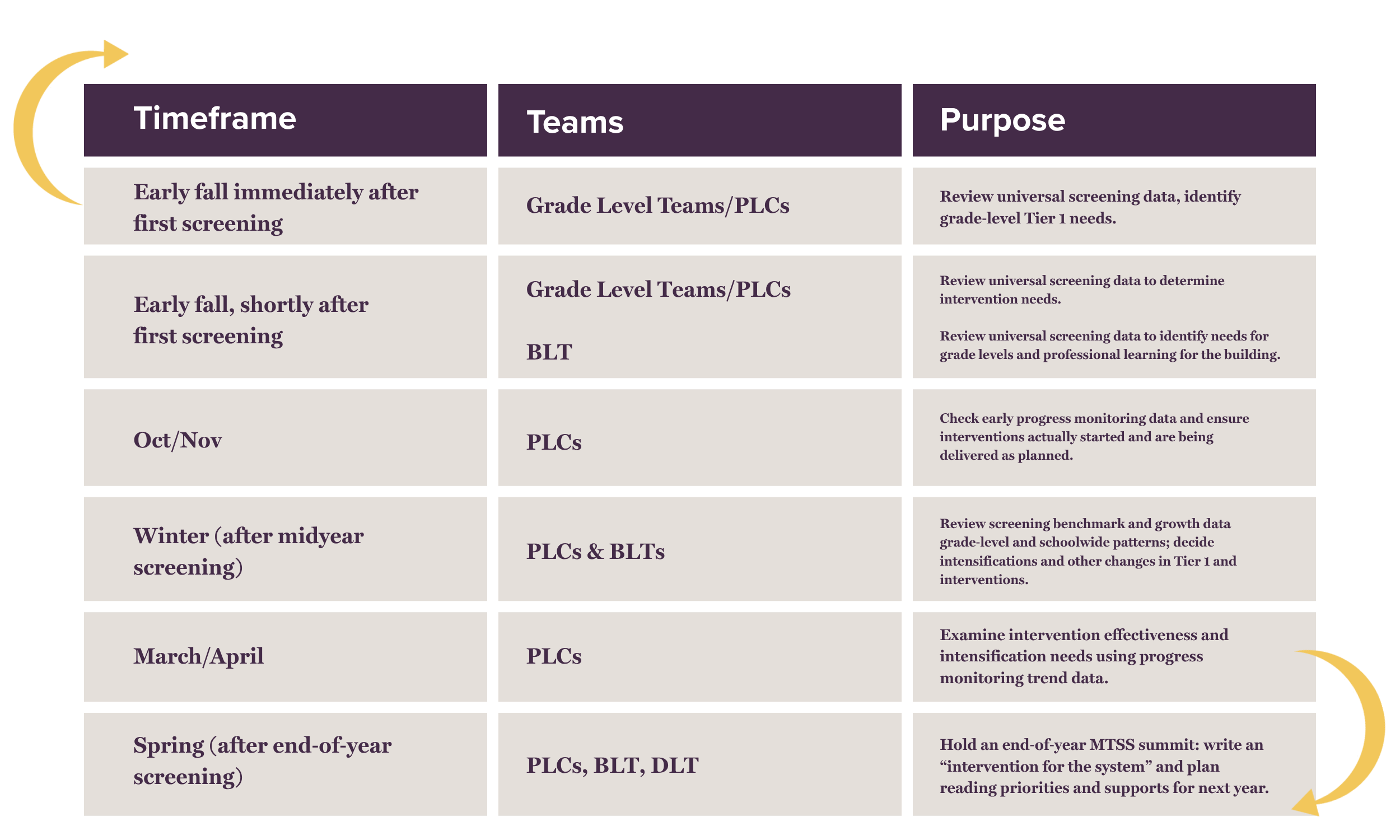
Every one of these meetings can run on a ready‑made agenda from MTSS for Reading Improvement and be supported by MTSS Data Academy protocols, so teams don’t have to start from a blank page.
Different teams, different questions, shared goals
The questions we ask determine our perspective and different teams have different perspectives on local data.
Grade Level Teams/PLCs: Closest to Instruction
PLCs live where instruction happens, so their data meetings should focus on what needs to change in teaching and intervention for the entire class and for groups of students, not solely on discussing individual students. This team answers questions like:
What does screening tell us about this grade level overall?
Do we need Tier 1 intervention (intensifying Tier 1) because we have more students who need intervention than we can serve?
Who needs additional small‑group or intensive support, and what will that look like?
Building Leadership Teams: Interventions for the System
BLTs look across grades and ask, “What in our system is helping or getting in the way of reading success?” The job of the BLT is to support teachers to have strong success within their classrooms every day.
District Leadership Teams: Coherence and Vision
DLTs focus on coherence and sustainability: shared assessment windows, common decision rules, and targeted support for schools. They can:
Ensure every school is clear on the assessment calendar and understands the vision for reading teacher & learning and school improvement within the district.
Use cross‑school data to decide where to aim MTSS Data Academy coaching and follow‑up support.
When PLCs, BLTs, and DLTs all use a shared set of tools and follow a predictable rhythm of meetings, data moves smoothly up the system, and support moves reliably back down to teachers.
Remember Progress Monitoring
Universal screening three times a year is not enough to drive every student decision. Students receiving supplemental and intensive interventions need regular progress monitoring and teams need time set aside to review those data and decide whether to stay the course or intensify their interventions.
Progress monitoring is only powerful when it actually guides action and that requires:
Assigning clear ownership and a schedule so each student’s data is regularly collected;
Scheduling regular times to review progress data as a PLC, preferably during already-occurring meeting times; and
Adjusting dosage, focus, or other variables when necessary to ensure students make catch-up growth.
A simple next step
If your teams are using MTSS for Reading Improvement or participating in the MTSS Data Academy, you have tools to support them in their data use. To set teams up for success, do the following:
Publish universal screening and progress monitoring windows for the year.
Add standing data meetings for PLCs, BLTs, and the DLT in the week after each screening window closes (2 for fall), and add regular meetings for progress monitoring data review throughout the year, as well.
Provide teams with agendas and data protocols to ensure they are able to take action with their data (use those from MTSS for Reading Improvement and/or the MTSS Data Academy resource library as a starting point).
If it’s not on the calendar, it will not happen consistently. When you schedule MTSS data meetings now, and provide teams with strong tools and a clear purpose, you give your system a real chance to change students’ reading outcomes next year.